

Printed dresses continue to offer apparel brands a way to combine recognizable silhouettes with distinctive surface design. In the 2026 fashion landscape, industry coverage has highlighted expressive prints alongside wearable shapes and considered construction. The red printed midi slip dress with twist-front detail from Dongbang illustrates how print placement, fabric drape and neckline construction can work together in a single garment. For apparel developers, the key challenge is not simply choosing a print, but ensuring that it works with the garment's shape and manufacturing process.
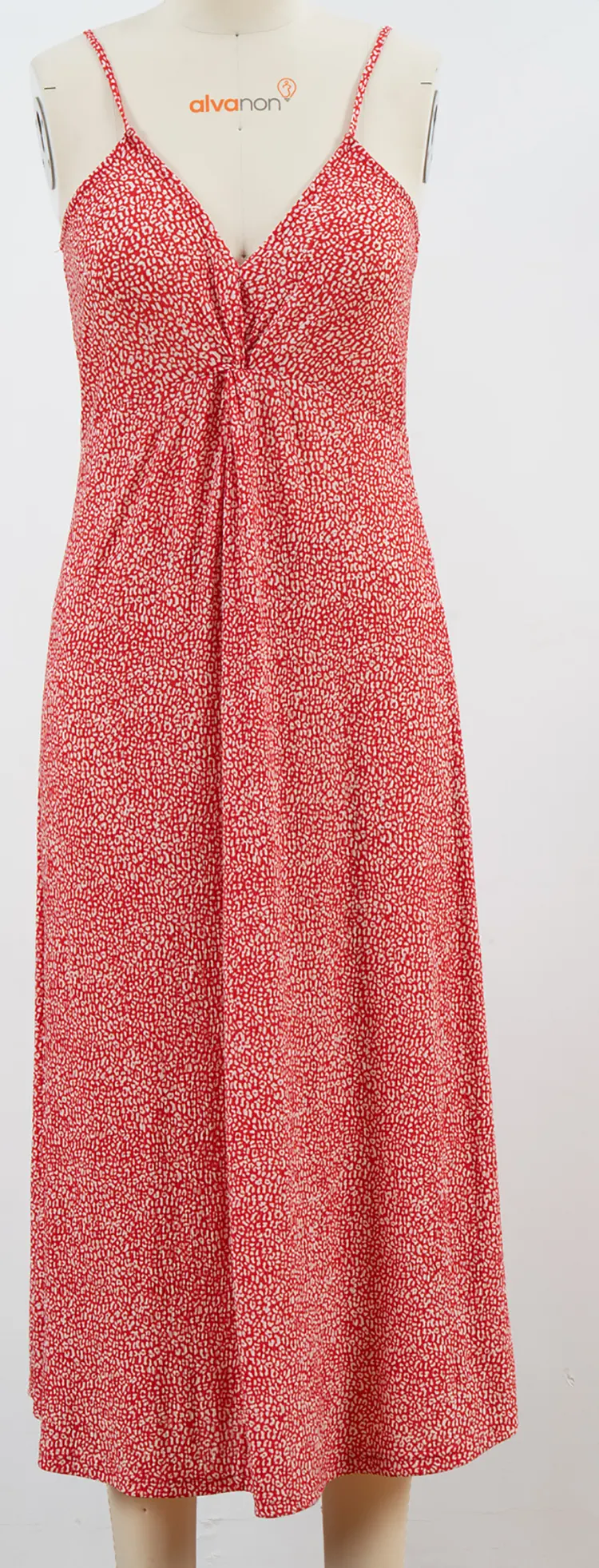
Red printed midi slip dress with a gathered twist-front bodice and slim straps.
1. Printed Dresses: Balancing Visual Impact and Wearability
Prints can distinguish a dress even when its overall silhouette is familiar. Color contrast, motif scale and pattern spacing all influence how a garment appears on a product page, in a showroom and when worn. However, a visually strong print does not automatically translate into a well-balanced finished product.
Recent fashion coverage has pointed to renewed interest in expressive patterns and dresses with distinctive proportions. For brands developing commercial collections, this creates an opportunity to explore statement colors and prints while retaining silhouettes that can be styled for different occasions. The direction should still be assessed against the target market, season, price positioning and existing collection.
The red-and-white design shown here uses a small irregular motif across a red ground. Rather than relying on oversized graphics, it creates visual texture through repeated patterning. The gathered front introduces another point of interest without requiring an additional bow or decorative accessory.
2. Why the Midi Slip Silhouette Remains Adaptable
A slip dress uses a relatively streamlined structure, allowing fabric choice, neckline details and print to play a prominent role. The midi length also creates room to adjust proportions without changing the basic design concept.
A Shaped Bodice
The fitted upper section establishes the neckline and chest proportions. On a twist-front design, the amount and position of gathering influence the depth of the V-neck and the way the fabric sits across the bust.
A Gently Widening Skirt
A skirt that gradually widens toward the hem provides movement while preserving a clean outline. For product development teams, skirt width and overall length need to be assessed together because changes to either can affect the garment's proportions.
Styling Flexibility
Depending on fabric, print and finishing, a printed midi slip dress can be developed for warm-weather daywear, holiday collections or occasion-led assortments. These are potential positioning options rather than a guarantee of market demand; the final use should match the intended customer and fabric performance.
3. Print Development and Fabric Drape
Print and fabric selection should be evaluated as a combined design decision. A motif may look evenly distributed on a flat fabric swatch but appear compressed, stretched or partially hidden once the material is gathered and shaped into a garment.
The DB0013 reference style uses 100% viscose plain-weave fabric at 140 GSM, with reactive digital printing applied before cutting. Its red base and small white irregular motifs provide a useful example of how a repeated pattern interacts with a shaped bodice.
| Development Factor | What to Review | Why It Matters |
|---|---|---|
| Fabric composition | Fiber content, hand feel, drape and care requirements | Influences how the dress hangs and how the garment should be handled. |
| Fabric weight | Actual GSM and behavior in the finished garment | Helps assess opacity, movement and suitability for the intended silhouette. |
| Print scale | Motif size, spacing and repeat alignment | Determines the visual balance across the bodice and skirt. |
| Color consistency | Red ground, white motif clarity and approved color references | Helps maintain consistency between approved samples and production fabric. |
| Dimensional behavior | Washing, shrinkage and care-related changes | Reduces the risk of unexpected changes to garment measurements. |
Before bulk cutting, the fabric should be checked against the approved color and print reference. Where the pattern includes a gathered center front, a garment sample is especially important because a flat swatch cannot fully show the final distribution of motifs.
4. How Twist-Front Construction Affects Sampling
The twist-front detail is created by controlled gathering in the center-front bodice. This construction gives the neckline its shape, but it also introduces several points that need to be reviewed during sample development.
These checks are particularly relevant when a style moves from a design reference to a production-ready garment. Clear measurements, construction notes and sample feedback help reduce avoidable revisions.
5. Quality Checks Before Bulk Production
For printed apparel, quality control should cover both the fabric and the completed garment. A fabric inspection alone cannot confirm how the print will look after gathering, stitching and pressing.
| Inspection Stage | Recommended Check |
|---|---|
| Fabric approval | Confirm composition, weight, color, motif definition and agreed fabric reference. |
| Pattern and sample review | Check neckline depth, gathering, strap placement, skirt shape and zipper position. |
| Measurement inspection | Measure the garment against the approved size specification using a consistent method. |
| Print and sewing inspection | Review visible motif distribution, seam appearance, hem finish and construction consistency. |
| Final garment review | Check overall appearance, closure function, labeling and any agreed packaging requirements. |
For the DB0013 base version, the proposed size range is S–XL. Its development measurements include overall length, chest, waist and hip widths. These are reference specifications and should be confirmed against the final tech pack and approved fit sample before production.
6. Development Considerations for Apparel Brands
When developing a printed midi dress with a shaped neckline, brands can improve the sampling process by preparing clear design and production information from the start.
Prepare a Complete Tech Pack
Include the reference image, graded measurements, fabric composition, target GSM, print artwork, color references, construction details and labeling requirements. Identify which elements are fixed and which can be adjusted during sampling.
Confirm the Print Before Cutting
Approve the base color and motif appearance on the intended fabric. If the design uses a gathered front, review the print on the assembled bodice to understand how the motifs appear after construction.
Review Fit and Construction Together
Neckline, strap length, bust gathering and overall garment length work as a connected set of measurements. Adjusting one feature may change the balance of the others, so sample comments should specify the intended change and the relevant measurement.
Align the Sample With the Production Brief
Before bulk production, confirm the approved fabric, color, print, size specifications, closure details and finishing. Dongbang develops apparel styles using tech packs, reference samples and specifications, with sample review used to assess construction and appearance before the production version is confirmed.
7. Frequently Asked Questions
The DB0013 base specification lists 100% viscose plain-weave fabric at 140 GSM, with reactive digital printing before cutting.
The detail is formed by controlled gathering of the bodice fabric rather than by attaching a separate decorative bow. The gathering affects the neckline shape and the visible print.
Review the approved fabric swatch and the finished bodice sample. Gathering can change motif spacing and visibility, so the flat fabric alone does not show the complete result.
The overall length can be reviewed during development. Because the style has fixed straps and a shaped bodice, length changes should be assessed together with the neckline and skirt proportions.
Key measurements include overall length, chest width, waist width and hip width. Strap length, neckline depth and front gathering should also be reviewed for construction and fit.
Provide a tech pack or reference sample, print artwork, fabric requirements, color references, size measurements and construction details. These inputs help the development team assess the design and prepare a sample for review.
Develop Your Next Printed Dress Collection
Discuss fabric, print placement, fit and construction requirements with Dongbang when developing printed midi dresses and other womenswear styles.
Contact Us